
Everyone is talking about the death of SEO and the rise of AI search
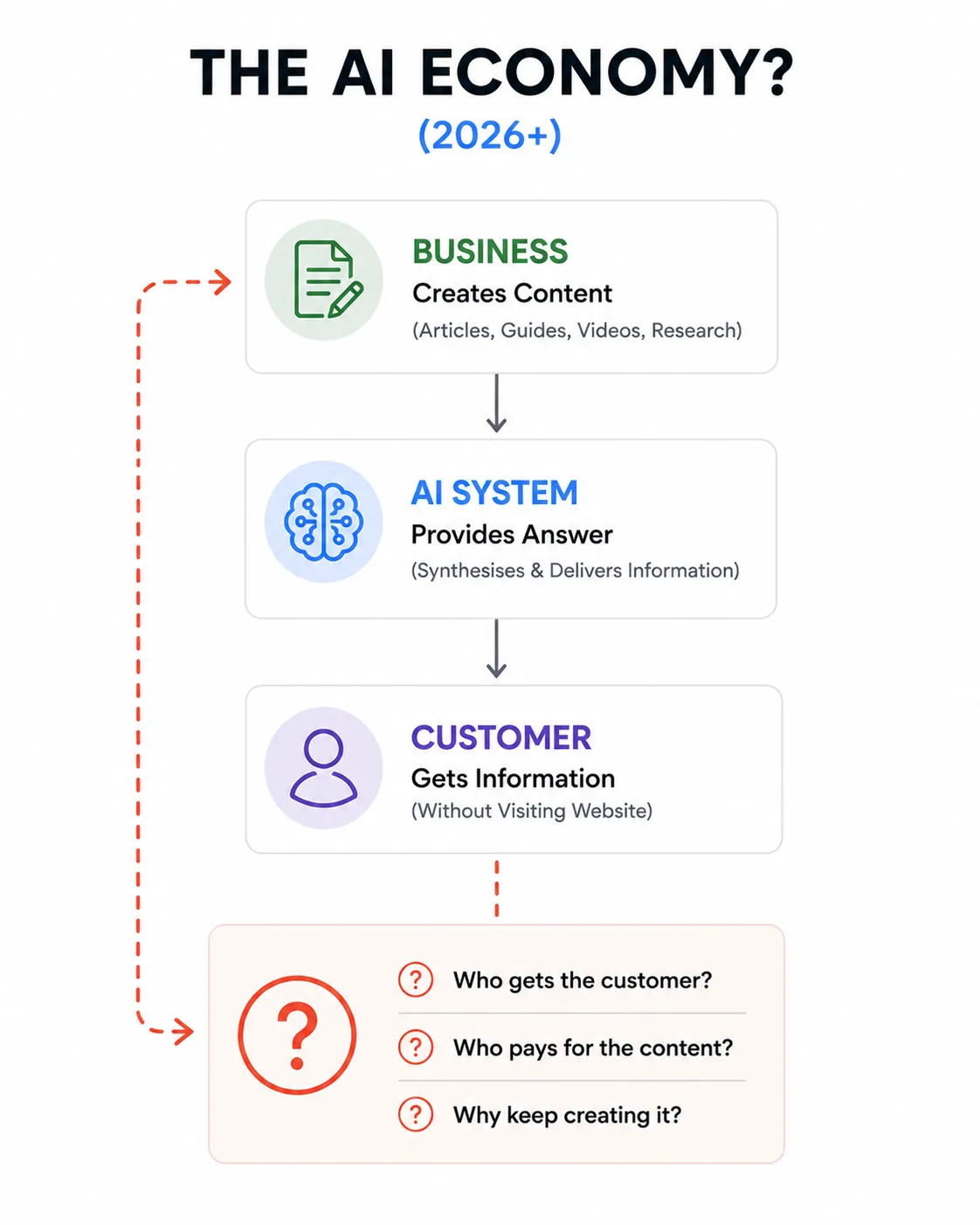
However, very few people are asking a more important question. If AI increasingly becomes the destination, who pays to create the knowledge behind the answers?
The real issue is not whether SEO survives. The real issue is as AI search grows: who will continue creating the knowledge that powers it?
For more than twenty years, the internet has operated on a simple exchange
Businesses created content, Google sent visitors, and some of those visitors became customers. Business made money. It was not a perfect system, but it worked well enough to create entire industries around search. Not to mention made Google billions.
Manufacturers published technical information. Engineering firms shared expertise. Consultants wrote guides. Insurance advisers explained complex products. Software companies created tutorials and training resources. The content generated traffic, and the traffic generated business.

Now AI may be about to break that relationship
Instead of sending visitors to websites, AI increasingly provides the answer itself. A user asks a question, receives a summary, and moves on. There is no need to click through to the original source. From a consumer’s perspective, this is fantastic. It is fast, convenient, and often very effective.
From a business perspective, however, not so good.
If nobody is visiting your website, why would you continue creating content? Content is not free. Technical articles take time to write. White papers cost money to produce. Research requires expertise. Case studies involve real work. Many businesses have spent years building valuable online knowledge because there was a clear return on investment: Search engines sent potential customers.
But what happens when the search engine becomes the destination?
That is the question very few people seem willing to ask.
Businesses should be paying attention because if the search economy is ending, many of the assumptions that have guided digital marketing for the last twenty years will end with it.
AI systems do not create knowledge. They organise it. The original knowledge still comes from somewhere. It comes from engineers designing products, manufacturers solving problems, researchers conducting studies, journalists investigating stories, and business owners learning lessons through experience. AI may package the information, but knowledge and expertise create it.
Who will continue creating the knowledge that AI depends on if the rewards for creating that knowledge begin to disappear.
Most businesses simply want customers
Content was never the goal. Content was the vehicle. The customer was the destination. Businesses created content because search engines connected knowledge with demand. Whether through organic rankings or Google Ads, the objective was simple: get in front of potential customers and win their business.
If that model stops working, businesses will change their behaviour.
Most businesses are not media companies, although many now hire agencies and specialists to create content on their behalf. A manufacturer does not want to become a YouTube creator. An engineering firm does not want to become an influencer. A wholesaler does not want to spend its days producing social media content.
Some may stop publishing detailed information altogether. Others may place more content behind paywalls. Some may licence information directly to AI companies (see an example of this in the video below, where a publisher sells its content to LLMs). Others may block AI systems completely.
For the first time in the history of the internet, businesses may start asking a question that would have sounded ridiculous ten years ago.
Is it still worth producing content?
Even as I write this article, I cannot guarantee that many human eyes will ever read it. An AI may summarise it. An AI may answer a question using ideas from it. Yet the article itself may never receive the visitor.
That is the uncomfortable reality at the heart of the AI economy.
If the connection between content and customers weakens, businesses will inevitably begin questioning whether giving away their knowledge still makes commercial sense.
The AI Knowledge Economy is a series exploring how artificial intelligence may reshape search, content, intellectual property, websites, and the economics of information. As AI changes the way people find answers, businesses may need to rethink how knowledge is created, distributed, protected, and monetised